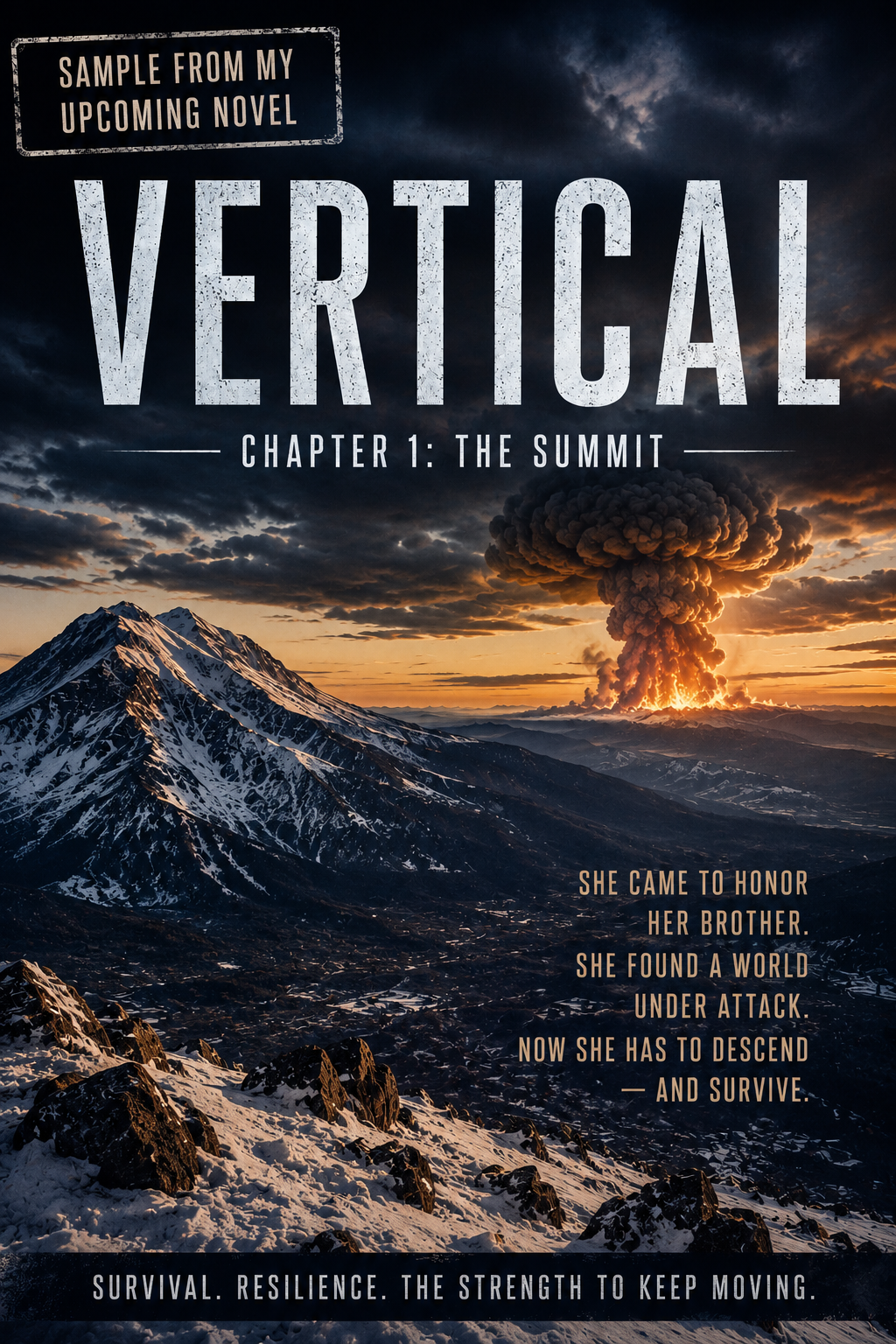
VERTICAL
Chapter 1
The Summit
Breathing the crisp mountain air above fourteen thousand feet felt like it stripped my ribs bare, shocking life back into muscles dulled by hours of climbing. I had pushed up from camp through the early morning dark, fighting high winds and near-whiteout conditions, front-pointing steep snow with an ice axe in one hand and a hiking pole in the other. Now, standing on the summit of Mount Shasta, exhaustion gave way to something else entirely.
Mount Shasta felt unlike any peak I had ever climbed, her presence rising from the volcanic spine beneath my boots. The Cascades stretched endlessly below, ridgelines stacked and fading into the distance. I set down my axe and pole and sat cross-legged in the snow, letting the sun warm my skin, already exposed too long at altitude.
Then, on the far horizon, the light changed. A violent flash bloomed into a towering plume, rising fast, spreading outward, too symmetrical, too deliberate. Colors churned inside the cloud as it climbed.
Was I delirious?
It couldn’t be what it looked like. Scenes like that belonged to textbooks. Hiroshima. Nagasaki. Not here. Not on American soil.
How far away was it?
There was only dead silence, broken by the wind tearing across the summit. Then came a low, distant rumble that vibrated through the mountain and into my chest. It settled the question instantly. I could not stay here.
I needed to move, and fast.
If I descended toward civilization, who knew what I would find waiting below. The range, however, stretched on for hundreds of miles. I knew exactly how little food and fuel I carried. I didn’t know how long my body could endure the altitude, but staying high and traversing the mountain felt like the only option that made sense.
I could not stay on the summit.
Whatever had been hit was somewhere below. Roads meant towns. Towns meant people, and people might mean targets. For now, the mountains felt safer.
Mountaineering was still new to me. I had climbed several peaks, most far less technical than Shasta. Mount Hood had been my first guided climb. I had chosen Shasta because it was the anniversary of my brother’s death. This climb was supposed to be for him.
Turning my back to the exposure was the part of downclimbing I resented most. Every instinct screamed against it. But I needed to drop lower along the ridgeline, to breathe easier, to follow the spine of the mountain away from whatever was unfolding beyond the horizon.
One step at a time, always maintaining three points of contact. The axe stayed in my lead hand, while my free hand pressed into the slope for balance. I placed my boots deliberately, searching for firm rock, careful to avoid loose talus and thin patches of ice. On the steeper rolls of terrain, I turned in and downclimbed facing the mountain. When the angle eased and the footing improved, I turned back outward and continued lower, steadying myself with each step.
The wind turned brutal, surging with flurries that whipped at my shell and tore at my hair. Without my goggles and balaclava, my face would have been raw with windburn in minutes. The gusts howled across the ridge, carrying something feral in their sound, deepening the unease already coiled in my chest.
To think that in my lifetime, of all times, the world would come under siege while I stood on top of it. While I had chased summits and silence, everything beneath me was unraveling into chaos.
I had not planned to stay at altitude for days.
I turned up my radio, cycling through static until a voice finally broke through, thin and distorted.
“Please take cover. We are under attack.”