Writer’s block crept up on me slowly, even though at the time it felt instant. Looking back, I can see it was a slow burn, gradually eating away at something that had once felt like part of my identity.
It began with obsessive thinking about what I should or shouldn’t write. I became increasingly aware of who might be reading my blog, what they might think, and what they might interpret from my words. The more I thought about my audience, the harder it became to write at all. I had created my own analysis paralysis.
Eventually, I started comparing how well my books were doing to my blog traffic. Numbers became a measurement of whether my writing mattered.
It didn’t help that I began paying close attention to how people in my personal life reacted to my posts. Some of that concern was warranted because, somewhere along the way, I had started using my blog as a diary.
That is something I don’t recommend.
Nearly every poem, short story, or reflection revolved around whatever emotional state I happened to be in at the time. Writing can be an incredibly healthy way to process emotions, but I eventually learned that not everything I write needs to be published.
Some things are meant to remain private.
A lot of my followers were supportive, but after the emotions behind certain posts wore off, I became embarrassed by what I had shared.
Then embarrassment turned into shame.
I started deleting posts.
Eventually, I deleted the entire blog, which was an overreaction but at the time felt like life and death. I just wanted to disappear.
Shame was the kiss of death to my writing journey.
After that, I could occasionally bring myself to write a short poem, story, or think piece about something I felt viscerally. But once the emotion passed, the writing almost felt foreign to me. I would look back at it and distance myself from the person who had written it.
After deleting my blog, I turned more deeply toward other areas of my life. I returned to my faith. I went to therapy. I started eating healthier, working out, and focusing on self-love and personal growth.
Those things helped me tremendously as a person.
But they did not immediately give me my writing back.
I still wanted to write desperately, and year after year seemed to slip by.
Eventually, I realized the shame wasn’t only connected to my old blog posts.
I was also ashamed because I had spent years comparing myself to other writers.
Traditionally published writers.
Best-selling writers.
Indie writers who somehow broke through and built enormous audiences.
Writers with millions of copies sold, film and television deals, awards, publicity, and careers that seemed impossibly far from mine.
Comparison is probably one of the fastest ways to torture yourself as a virtually unknown independent artist.
Recently, a friend who is pursuing traditional publication reminded me of my own short-lived experience querying literary agents when I was 21 in 2016.
I sent dozens of queries and received a mixture of rejections and non-responses. Most offered no explanation.
At the time, it hurt.
Looking back now, I can see the experience differently.
Maybe I could have spent more time polishing the manuscript before querying. Maybe I could have kept submitting longer. Literary agents are busy, publishing is subjective, and the type of story I was writing existed in an already saturated market.
Instead, I went back to the drawing board.
I hired editors for several rounds of developmental, line, and copy editing. I hired a professional cover designer. Then I published my books independently.
What I didn’t have was professional advertising, a large promotional campaign, bookstore placement, book signings, or an existing audience waiting for the books.
Still, somewhere along the way, I began treating the books’ commercial performance as proof of their artistic value.
If I couldn’t sell thousands of copies or get my name out there, it felt personal.
I stopped proudly telling people I was a self-published author.
I kept it listed on my LinkedIn because publishing books had unexpectedly helped open doors professionally. I didn’t have what I considered a traditional “real” career until my mid-twenties, and being an author and longtime content creator showed employers that I could communicate, complete large projects, and build something independently.
But socially, I dreaded certain conversations.
Someone would ask what my books were about.
I would attempt to summarize a complicated fantasy story in a few sentences.
Then sometimes came the question I hated most:
How many copies have you sold?
I honestly didn’t know the exact number.
I just knew it wasn’t thousands or millions.
Ratings were another source of anxiety. Some were high. Some were low. To this day, there are ratings with no written reviews explaining them. I had no way of knowing whether someone gave a book two stars because they expected something different or hated the concept, or five stars because they genuinely loved it or were simply being supportive.
Eventually, I had to accept something obvious that is strangely difficult to accept when the art belongs to you:
Art is subjective.
Some people will love what you create.
Some people will dislike it.
And neither reaction determines whether you were allowed to create it.
Another lesson I’ve learned as an artist is that many of your supporters will not be the people closest to you. Most of my close family and friends have never read one of my novels, even when I gave them a copy for free.
At first, that hurt.
Eventually, though, I found a strange freedom in it. There is something liberating about expressing yourself to people who don’t already know you intimately. They encounter the work first rather than filtering it through everything they already know about the person who created it.
That doesn’t mean I haven’t received support from people in my personal life. Friends, family members, coworkers, acquaintances, and people I’ve met in passing have supported my work over the years, and I genuinely appreciate them for it. But I’ve also learned that telling someone I create art doesn’t obligate them to consume it.
I once had a conversation with an independent rapper on SoundCloud about this exact frustration. We talked about how strange it can feel when the people closest to you show little interest in your work but enthusiastically talk about other artists. It can sting. There can even be a little envy in hearing someone you love praise another artist when you’ve been quietly hoping they might show that same enthusiasm for you.
But I understand it differently now. There is a certain freedom in experiencing art when you are divorced from intimacy with the artist. When you know the person behind the work, sometimes it is difficult to separate what they created from everything you already know about them. A stranger doesn’t have that baggage. They can simply meet the art where it is.
After nearly eight years away from publishing and six years from serious fiction writing and after shelving years that I could have spent advertising, promoting, submitting to competitions, or building an audience, I finally did something that frightened me.
I reread my books.
These were stories I had begun writing as a teenager and in my early twenties, then published when I was only 23 and 24.
For years, I had almost convinced myself that I should be embarrassed by them.
Then I actually opened them again.
And I was proud.
That surprised me.
Of course, I found things I would change now. There were sentences I would tighten and small edits I would make. Eight additional years of life and writing experience will naturally change how someone approaches prose.
But I did not find the disaster I had built up in my mind.
I found stories.
I found imagination.
I found ambition.
I found a younger version of myself who had created entire worlds, finished full-length novels, worked with professional editors, and had been brave enough to put those stories into the world.
She deserved more grace than I had given her.
That realization changed something for me.
My writer’s block was never simply a lack of ideas.
I had never stopped imagining stories.
I had become afraid of what writing represented.
Rejection.
Embarrassment.
Comparison.
Failure.
Exposure.
I had made writing so closely connected to my worth that eventually the safest thing seemed to be not writing at all.
The strange thing about returning to my work now is that I am not the same person who stopped.
Years have passed.
I have traveled, worked in nonprofit organizations, government, healthcare, and technology. I have spent more than a decade creating content online, which has taught me its own lessons about algorithms, audiences, growth, plateaus, and the danger of constantly comparing your progress to someone else’s.
I have lived considerably more life.
And now I get to bring all of that life back to the page.
I don’t know exactly where my writing career will go from here.
Maybe my audience will grow quickly.
Maybe it will grow slowly.
Maybe the readers who connect deeply with my stories will find them years from now.
That part is largely outside my control.
What I can control is whether I continue creating.
So I am writing again.
I am revisiting old stories, finishing new ones, documenting the process, and allowing writing to become something I enjoy rather than something I constantly use to measure myself.
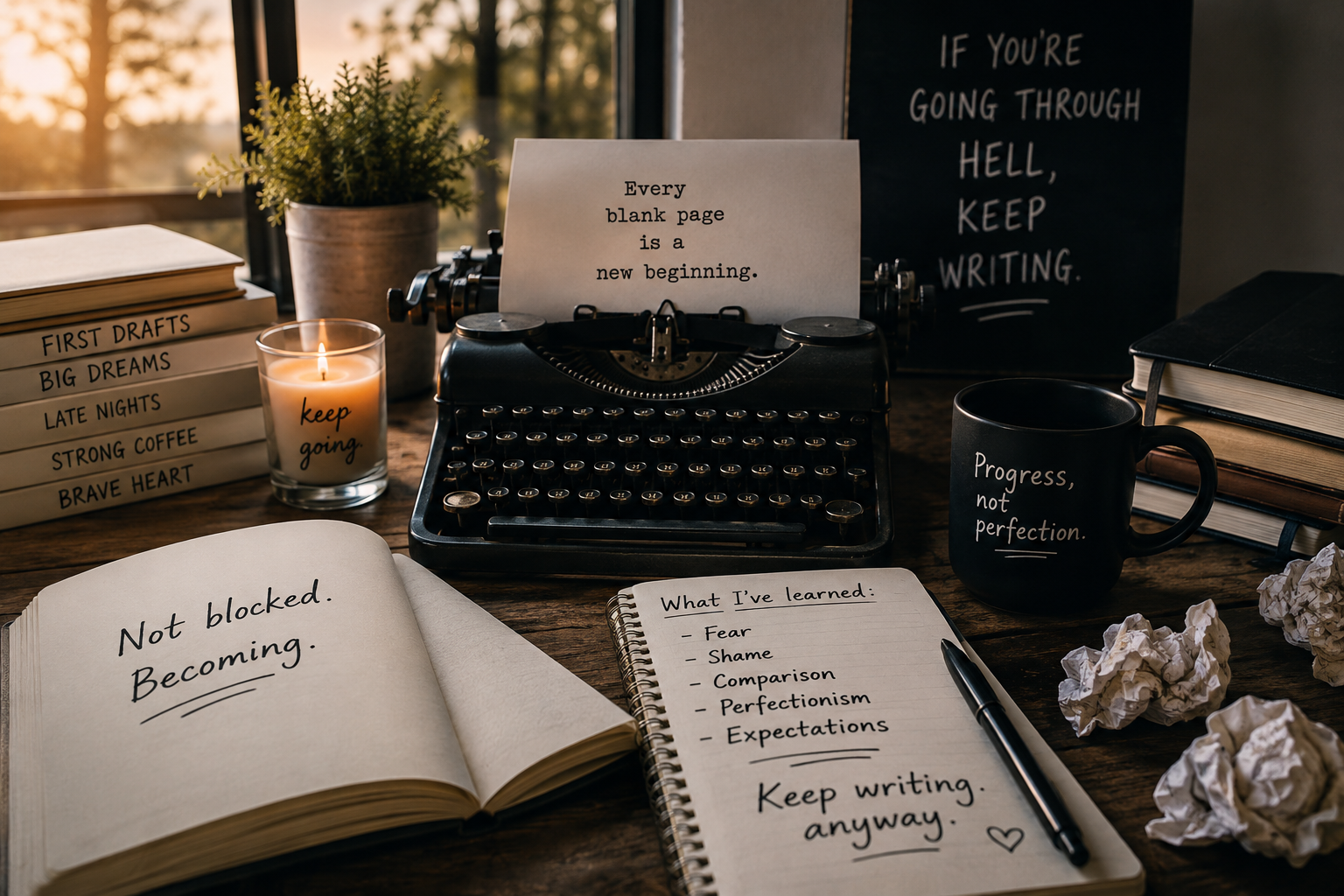
The biggest thing I have learned about breaking writer’s block is that sometimes the block isn’t on the page.
Sometimes it is everything we have attached to the page.
Fear.
Shame.
Perfectionism.
Comparison.
Expectations.
And sometimes getting your voice back begins with forgiving the person who first had the courage to use it.
I spent years waiting to feel like I had earned the right to call myself a writer again.
I don’t want to do that anymore.
Whether the right readers find me tomorrow, next year, decades from now, or even after my death, I would rather spend my life writing than waiting for permission to begin.